ISO 9001:2026 Published: What Changes and What Certified Organisations Should Do
ISO 9001:2026 was published on 16 September 2026. Here are the key changes, the expected transition period and a practical plan.

- Published
- Written by
- SRA INT
- Section
- Newsroom
- Related service
- ISO 9001 Certification
In this article7 sections
Quick answer: ISO 9001:2026 was published on 16 September 2026, replacing ISO 9001:2015. The changes are targeted rather than radical: more focus on quality culture and ethical behaviour, separate treatment of risks and opportunities, stronger change management and closer alignment with other ISO standards. Certified organisations are expected to have three years to transition.
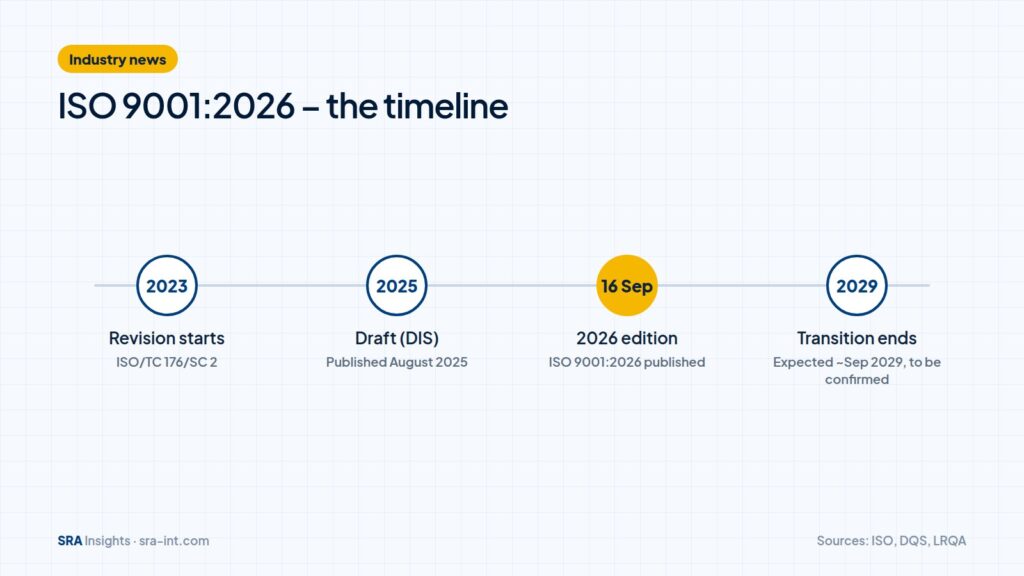
After a revision process that began in 2023, the sixth edition of the world’s most widely used quality management standard is now official. ISO 9001:2026 was published on 16 September 2026, and the transition period for the more than one million ISO 9001 certificates in use worldwide has started.
If your certificate says ISO 9001:2015, there is no need to panic. Your certificate stays valid during the transition. But this is a good moment to understand what has changed and plan your update calmly instead of rushing before a deadline.
What changes in ISO 9001:2026?
The revision keeps the foundations organisations already know: the process approach, the Plan-Do-Check-Act cycle and risk-based thinking. Certification bodies that have reviewed the final text describe the changes as an evolution of the 2015 edition. The main themes are:
- Quality culture and ethical behaviour: leadership is now expected to actively promote a culture of quality and ethical conduct, not just commit to a policy.
- Risks and opportunities separated: the 2015 edition dealt with them together; the new edition gives each its own requirements.
- Change management: clearer expectations for planning, communicating, implementing and reviewing changes to the management system.
- Climate change and context: the 2024 climate change amendment, which asks organisations to consider whether climate change is relevant to their context, is built into the standard.
- Alignment and terminology: the text follows ISO’s latest harmonised structure, and selected quality terms are now included in the standard itself, alongside the revised ISO 9000:2026 vocabulary published earlier in 2026.
How long is the transition period?
A three-year transition is expected, which points to a deadline around September 2029. The formal transition rules are set by the international accreditation community, now organised under Global Accreditation Cooperation Incorporated (Global ACI), so treat the date as provisional until your certification body confirms it. You can read more about the new accreditation body in our article on the IAF and ILAC merger.
In practice, most organisations will move to the new edition at a scheduled surveillance or recertification audit, which usually avoids an extra audit visit.
What certified organisations should do now
- Get the standard. Buy ISO 9001:2026 from ISO or your national standards body and make sure your quality team reads the full text, not just summaries.
- Run a gap analysis. Compare your current system with the new requirements. For most mature systems the gaps will be small and concentrated in leadership, risk and change management. Our gap analysis service can help.
- Gather evidence of quality culture. Think about how leaders demonstrate commitment in practice: communication, recognition, how problems are raised and handled.
- Split risks and opportunities. Review your risk register and make sure opportunities are identified and acted on in their own right.
- Formalise change management. Document how changes to processes, people and systems are planned and reviewed.
- Retrain internal auditors. Auditors need to know the new requirements before they can audit against them. See our ISO training courses.
- Agree a timetable with your certification body. Decide which audit visit will cover the transition.
What about organisations seeking certification for the first time?
If you are just starting, build your system to the 2026 edition. Certification bodies may continue to certify to the 2015 edition for part of the transition period, but a new system built on the old edition would need updating soon afterwards. Our step-by-step guide to the ISO 9001 certification process explains how certification works from gap analysis to certificate.
What this means for the GCC and Pakistan
ISO 9001 is a common prequalification requirement for contractors, suppliers and service providers across Saudi Arabia, the UAE, Qatar and Pakistan. Expect major clients and tender documents to start asking for ISO 9001:2026 certificates as the transition progresses. Suppliers who plan early will avoid a last-minute rush in 2029, when auditor availability is likely to be tight.
Key takeaways
- ISO 9001:2026 was published on 16 September 2026.
- Changes are targeted: quality culture, separate risks and opportunities, change management, climate and terminology.
- A three-year transition is expected, to around September 2029, subject to accreditation rules.
- Existing ISO 9001:2015 certificates remain valid during the transition.
Frequently asked questions
Is my ISO 9001:2015 certificate still valid?
Yes. It remains valid until you transition or the transition period ends, whichever comes first.
Will the transition need a separate audit?
Usually not. Most organisations transition during a planned surveillance or recertification audit, sometimes with a little extra audit time.
Are the changes big?
For most well-run systems, no. Expect updates rather than a rebuild, mainly around leadership, risk and change.
Has ISO 9000 changed too?
Yes. ISO 9000, the vocabulary standard, was revised alongside ISO 9001 and published in 2026.
Plan your transition with SRA: learn about ISO 9001 certification or talk to our team.